World Wine
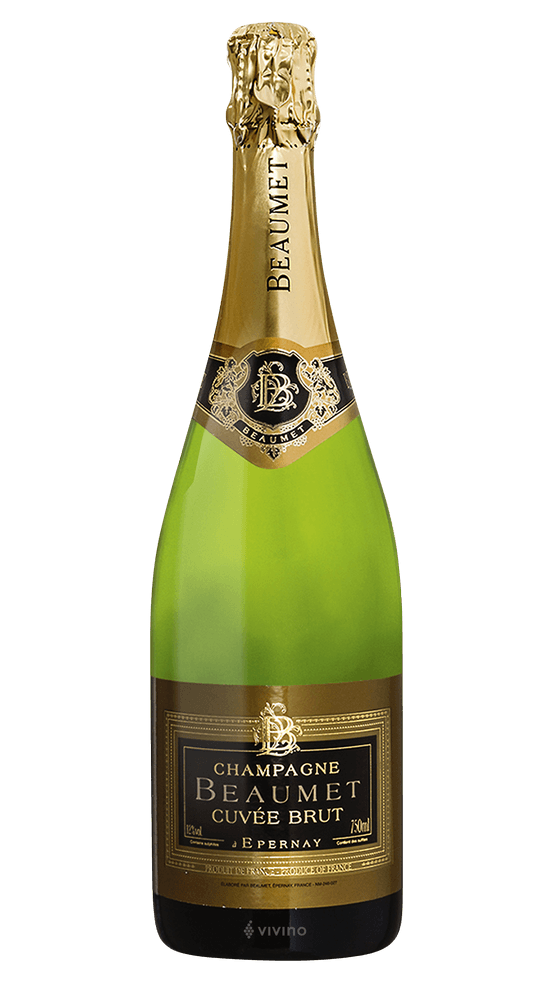
CHAMPAGNE BEAUMET – Brut Cuvée
Taste
pear
white peach
citrusy
Vegan
5 in stock
Couldn't load pickup availability
Wine type - White
Variety - 40% Pinot Noir, 30% Chardonnay, 30% Pinot Meunier
Style - Brut (dry sparkling wine, traditional method)
Origin - France
Region - Champagne (Épernay)
Cellaring - 3–5 years, up to 7 years under ideal storage conditions
Volume - 0.75 l
Alcohol - 12%
-
About wine:
Cuvée Brut is the result of blending thirty different wines (both young and older), carefully selected to preserve the distinctive Beaumet house style every year. The proportions of these thirty base wines therefore vary from year to year.
The wine is made from three grape varieties typical of the Champagne region: Pinot Noir – 40%, Chardonnay – 30%,
Pinot Meunier – 30%
Vinification takes place at a low temperature (16–18 °C) in small stainless steel tanks. The wine is only lightly filtered to preserve its finesse and aromatic character.
Secondary fermentation in the bottle (prise de mousse) takes place approximately 30 metres underground in chalk cellars carved into the bedrock. A constant temperature of 10 °C ensures slow fermentation and produces a fine, persistent effervescence.
-
Harvest and ageing:
Throughout the Champagne region, hand harvesting is required by law (AOC). Machines may not be used.
Reasons:
to keep the grapes intact (so they do not start fermenting in the vineyard),
to ensure high-quality raw material for Champagne production,
to limit damage to the berries.
2) Careful selection of grapes
The harvest in Champagne (vendange) usually takes place in September, but winegrowers set the date according to ripeness and sugar content.
Whole bunches of the following varieties are picked:
Pinot Noir, Pinot Meunier, Chardonnay
The grapes must be healthy and undamaged, and must not have begun to ferment.
3) Careful transport in small crates
The picked grapes are placed in small plastic or wooden crates so they are not crushed under their own weight.
The crates are perforated so juice can drain away and oxidation can be prevented.
4) Immediate transport to the press
The grapes are pressed as soon as possible after harvesting, often right near the vineyard.
Champagne has traditionally used large basket presses (pressoirs); modern pneumatic presses are also used today.
For Champagne, the grapes are pressed very gently – only a certain volume of juice may be obtained from each kilogram of grapes.
5) Separate must fractions
Pressing is divided into:
cuvée – the highest-quality first juice
taille – the second pressing fraction
Each fraction has a different use in the finished wine. -
Suitable for food pairing
🐟 Fish and seafood (the best pairing)
oysters, shrimp, salmon carpaccio, tuna tartare,
sushi & sashimi, grilled Saint-Jacques scallops
🧀 Cheeses
French soft cheeses: Brie, Camembert,
mild goat’s cheeses, young Comté, Chaource (a Champagne specialty)
🥂 To accompany an aperitif
light finger foods, canapés with smoked salmon
prosciutto, mini quiche Lorraine, olives and almonds
chicken suprêmes, turkey roulades, veal cutlets
-
About the winery
Champagne Beaumet is a traditional Champagne house based in Épernay, the heart of the region’s most prestigious wine-growing area. Founded in 1878, the winery has specialized from the outset in producing elegant, harmonious and consistently well-balanced Champagnes that reflect the region’s classic style.
The Beaumet house is best known for its philosophy of “consistency of style,” achieved through the careful blending of wines from different vintages. The aim is to create a cuvée with the same character every year: fine bubbles, balanced structure, purity and elegance.


